
Automation can be a good solution to labor issues, from picking to packaging.
If you’re headed to MODEX this April, a trip around the show floor will quickly tell you what’s most in demand today: automated solutions to help with the labor shortage. With fewer people to fill labor-intensive warehousing jobs from picking on through to packaging, robotics and other automation is there to fill the void.
That’s important because the labor shortage is showing no signs of slowing down. As boomers and Gen X retire, the millennial and Gen Z generations aren’t backfilling manual labor jobs. When they do take a warehousing floor job, they often prove unreliable—a warehouse down the road might pay 50 cents more per hour, making it tempting to start a job, quit shortly thereafter, and head to the other warehouse. Competition can quickly tank your available labor pool.
Automation, then, is a valid solution, especially as prices for equipment and software come down. The tools can serve you twofold: by both replacing labor that’s increasingly unavailable and providing tech tools that make the work employees do more appealing. Gen Z was raised as digital natives. When they can swap out manual picking for overseeing robotics or software, they’re happier and more likely to start and then stay on the job.
Robotics can play a role from picking to packing. This helps with the labor issues and also reduces errors, gets products out the door faster, and lowers your overhead.
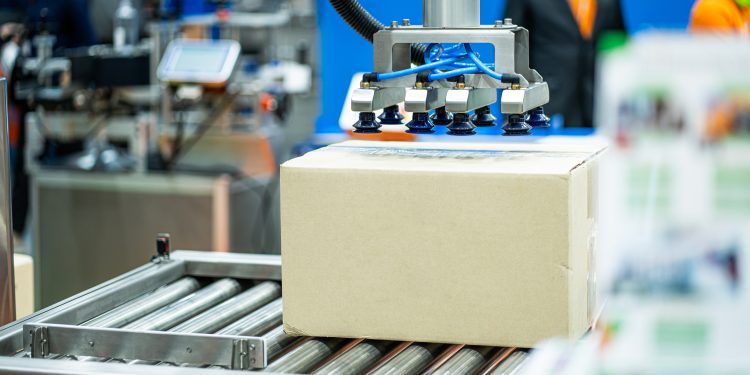
Beginning in the picking area, robotic picking systems can automate item identification, retrieval, and transport of items. This removes the physical demands—and the mental fatigue—that comes along with traditional, manual picking operations.
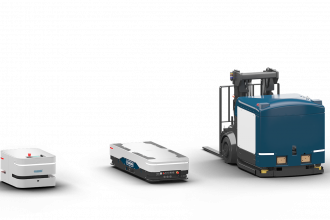
Among the robotic solutions in picking are robotic arms, which pick items and place them into designated totes or containers. Humans, or automation, can then move the filled totes onto an automated guided vehicle (AGVs), or autonomous mobile robots (AMRs). The first follows a predetermined path and remains guided, while the latter utilizes sensors to move freely about the warehouse. They can transport the totes onto a packing station and the SLAM line (scan, label, apply, manifest), which itself is automated. Here, once again, automation replaces or enhances human capabilities, leading to improved packaging processing and efficiencies.
No automation can operate without modern software to control and integrate with it. In most cases, companies already have a WMS in place, operating as the “brain” of operations. To integrate with robotics, you must ensure your WMS is up to date and can coordinate robot movements and inventory data. Your WMS should also be capable of talking to warehouse execution systems, too. The two systems should seamlessly exchange data, providing a real-time picture of tasks and their completion. In some cases, there may also be specific robotics control systems that you’ll need to work into the flow.
If automated picking and packing is appealing to you, the good news is that the cost of the solutions continue to come down. Just as big-screen TVs were once unaffordable, robotics and automation in the warehouse are more affordable every day. The same holds true for the software that is required to run automation. From WMS to WES and WCS, the costs are dropping. Large operations like big-box retailers and 3PLs have already adopted the tools, but today, small- and medium-sized companies can find solutions within their budgets. Return on investment can be relatively quick, further justifying the costs.
When fully implemented and integrated, robotics picking on through packing and shipping can give your accuracy and order fulfillment rates a substantial boost. You’ll experience lower return rates, fewer mis-shipments, and higher customer satisfaction. In an environment increasingly dependent on ecommerce, that’s important. Right along with the uptick in ecommerce is an uptick in customer demands. They expect their packages faster, in good shape, and with easy returns. A fully integrated and automated warehouse will greatly increase the odds that you can meet those expectations. This results in a loyal customer base.
In a demanding labor market, providing a workspace that minimizes heavy lifting, repetitive movements and risk of injury, you’re more likely to attract and hold onto workers. Not only that, but those same workers will be freed up to focus on more demanding, less labor-intensive tasks, which is a win-win scenario.
The best starting place for exploring your automation options is with an integrator or OEM. You can find the best resources by tapping into the Warehouse & DC Solutions Network. Talking with a skilled expert to analyze your operations and learn your options will guide you to the best choices, processes and layouts. All this equipment is scalable, too. You can start small and move up incrementally as the automation proves itself and your operations grow.
While lights out warehousing may live in the future, it’s not the distant future thanks to robotics that integrate smoothly from picking on through the SLAM line. It’s time for companies—big and small—to consider robotics and other automation to meet the demands of tomorrow’s warehouse, and the labor market. The best way to proceed is to form a plan and begin piloting automation.
Source: Greg Berguig, PAC Machinery
Reviewed by SLAM Industry Group Marketing Committee
To learn more about MHI’s SLAM industry group: www.mhi.org/slam
More information about Scanning, Labeling, Applying, Manifesting:
5 Major Reasons Companies are Automating Their SLAM Lines
The Business Case for SLAM Automation
Maintaining Your SLAM Equipment
Change Management on the SLAM Line
Monitoring Sensors on the SLAM Line for Trouble
SLAM Solutions in the Pharmaceutical Industry