

Knowing When to Replace Warehouse Automation Equipment
Deciding when to replace automated equipment is not easy. Whether you’ve been in warehouse operations for years or you’re just getting started, this is a decision every team faces. Make the wrong call, and it can hurt productivity and drive up operational costs. Make the right one, and you protect uptime while controlling long-term spend.
Understanding Equipment End of Life in the Warehouse
Managing the warehouse equipment lifecycle is about more than age. You also need to consider efficiency, safety, compliance, repair costs, disposal costs, and overall system reliability.
Tracking uptime, throughput, and energy use can help show when a piece of equipment is no longer performing the way it should. These signals often point to rising maintenance costs and growing risk of system failure.
This applies across all warehouse automation equipment, from conveyors and sortation to robotics and other automated equipment.
Why MTBF and MTTR Matter
Two metrics play a major role in understanding equipment performance:
- Mean time between failures (MTBF), also called time between failure MTBF
- Mean time to repair (MTTR), sometimes referred to as time to repair MTTR
MTBF tells you how long equipment typically runs before a failure. MTTR shows how much time it takes your maintenance team to fix the problem and get the system back online.
Some teams also track time to failure MTTF to understand how long components last before breakdown.
Together, these metrics help calculate mean time trends and reveal where reliability is starting to slip. They also support predictive maintenance and smarter maintenance strategy planning.
Maintenance data from your CMMS is critical here. If you are not tracking MTBF, MTTR, or time to failure today, start now. Without this data, it is difficult to make informed decisions about automated equipment.
If you are unsure where to begin, groups within Material Handling Industry of America offer practical resources on condition monitoring and system reliability.
Other Factors That Affect the Warehouse Equipment Lifecycle
MTBF and mean time to repair are important, but they are only part of the picture. You also need to look at:
- Asset condition
- Impact of downtime on inventory management and shipping
- Spare parts availability
- Software support and cybersecurity risk
- Regulatory requirements
- Sustainability goals
- Resale potential
- Ongoing maintenance tasks and labor availability
All of these influence operational costs and overall system performance. They also affect how much disruption a system failure creates across your warehouse operation.
This information helps teams move away from guesswork and toward data-backed decisions.
Balancing Cost and Risk
At the end of the day, equipment end of life comes down to balancing cost and risk. Every business approaches this differently.
A fast-growing operation with strong cash flow may replace automated equipment earlier to avoid downtime and improve system reliability. A smaller company may accept higher maintenance costs to avoid large capital spending.
Some teams prioritize uptime. Others focus on cost saving.
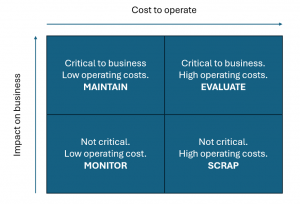
Neither approach is wrong. What matters is understanding your tolerance for risk and using real data to guide the decision.
Tracking mean time between failures, time to repair MTTR, and maintenance costs helps show when keeping aging equipment becomes more expensive than replacing it.
Taking a Practical, Data-Driven Approach
There is no single right answer to this problem.
The best approach is a practical, data-driven one. Use MTBF, MTTR, and MTTF to understand how your systems are performing. Review repair history. Look at how downtime affects inventory management and labor. Factor in how much time your maintenance team spends reacting to failures.
This allows you to see the true cost of ownership and identify opportunities for predictive maintenance.
Over time, this helps reduce unplanned downtime, control operational costs, and improve overall reliability.
Making Better Long-Term Decisions
Managing automated equipment is not just about today’s repairs. It is about long-term planning.
By investing time in understanding system reliability and maintenance trends, companies can reduce risk, improve uptime, and manage costs more effectively.
That leads to stronger strategies for warehouse automation equipment and more stable operations over the long term.
Frequently Asked Questions About Automated Equipment and Lifecycle Planning
What is MTBF and why does it matter?
Mean time between failures (MTBF), sometimes called time between failure MTBF, measures how long automated equipment typically runs before a system failure. A declining MTBF is often an early sign that reliability is slipping and maintenance costs are about to rise.
What does MTTR tell me about my warehouse equipment?
Mean time to repair (MTTR), or time to repair MTTR, shows how long it takes your maintenance team to fix a piece of equipment and return it to service. Higher MTTR means longer downtime, higher operational costs, and more disruption to inventory management.
How is MTTF different from MTBF?
Time to failure MTTF measures how long a component lasts before it fails for the first time. MTBF looks at repeated failures over time. Together, these metrics help calculate mean time trends and support predictive maintenance planning.
When should I replace warehouse automation equipment instead of repairing it?
Common signs include increasing maintenance costs, falling MTBF, longer MTTR, frequent system failure, or when your maintenance team spends too much time reacting instead of performing planned maintenance tasks. At that point, replacement may be more cost effective than continued repair.
How do these metrics help reduce operational costs?
Tracking MTBF, MTTR, and time to failure gives you real data to support informed decisions. This helps prioritize predictive maintenance, reduce downtime, control labor, and find cost saving opportunities across the warehouse equipment lifecycle.
What role does predictive maintenance play?
Predictive maintenance uses performance data to anticipate failures before they happen. This reduces unplanned downtime, lowers operational costs, and helps extend the long term life of automated equipment.
How does equipment reliability affect inventory management?
Unplanned downtime can delay picking, packing, and shipping, throwing off stock levels and order commitments. Strong system reliability keeps inventory moving and reduces disruption across warehouse operations.
Who should own equipment lifecycle planning?
It’s usually a shared effort between operations and the maintenance team. Operations understands workflow impact, while maintenance tracks system reliability and repair history. Together, they can build a smarter maintenance strategy.
Contributor: Joe Abeln, Fives Intralogistics Group
Reviewed by: MHI Solutions Community Condition Monitoring & Reliability Committee
For more information about the Solutions Community: mhi.org/solutionscommunity
For further articles from the Solutions Community:
Converging IT with OT Strategies
Go-Live Best Practices for Warehouse Automation
From If-Then to Intelligent Agents in Intralogistics Condition Monitoring
Cabinet-Free Warehouse Automation: Modular, Scalable Systems
Warehouse Worker Retention: How Automation Reduces Turnover
Post-Installation Training for Warehouse Automation
What Are the Benefits of Supply Chain Towers?
Types of Automation Integrators

