
Lithium-ion Batteries Come Full Circle
As lithium-ion battery technology improves, so does the ability to recycle that technology
You hear it all the time: recycling industrial materials not only helps the planet, it also makes solid economic sense. Lithium-ion batteries are no different. The ability to recycle these batteries is especially important because extracting lithium and other critical minerals from the earth is expensive and can be environmentally damaging. Why mine for new materials when existing ones can be reused? Members of MHI’s Advanced Energy Council (AEC) are helping lead the industry toward more efficient and sustainable lithium-ion battery recycling.
What’s inside a lithium-ion battery?
A lithium-ion battery contains a variety of components—and all of them can be recycled. Energy is stored in lithium-ion cells that contain the anodes, cathodes, and electrolytes responsible for charging and discharging. These cells can be cylindrical, prismatic, or pouch-shaped and are combined into packs to deliver the required energy output.
Between the cells are separator membranes and metal current collectors made of copper and aluminum. Batteries also include electronic components housed in durable plastic enclosures. While all of these materials are recyclable, they must first be separated through specialized processes.
Breaking it down
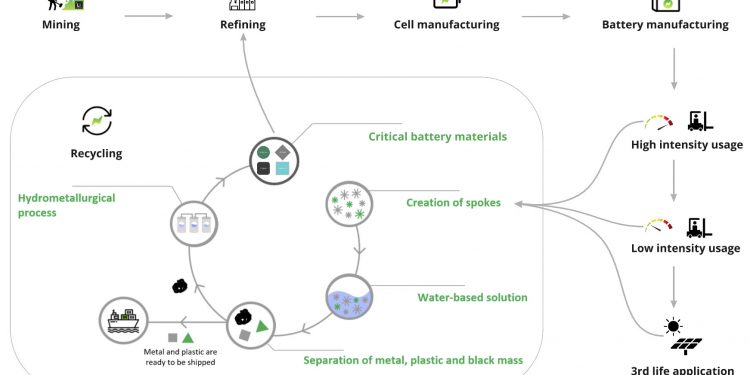
Recycling begins with shredding the battery, a process not unlike a large industrial paper shredder. Once shredded, plastics, aluminum, and other metals are separated and sent to the appropriate recycling streams—similar to the way household recyclables are handled.
The cell materials require additional processing. After shredding, what remains of the cells is known in the recycling industry as black mass. Extracting usable materials from black mass requires a chemical process called hydrometallurgy, which separates the individual elements. These materials are then sent to refining facilities and, ultimately, back to manufacturers to be used in new batteries—closing the loop.
Another important form of lithium-ion recycling happens without breaking down a battery at all. Battery manufacturing naturally produces excess materials. Instead of discarding them, manufacturers can immediately recycle this material back into production. This is why many recycling facilities are located near battery manufacturing plants. The result is less waste and lower costs, since manufacturers don’t need to purchase as much new raw material.
Getting the most from a battery before recycling
Lithium-ion batteries used in high-intensity applications—such as forklifts—must typically maintain between 80 and 100 percent of their nominal capacity for optimal performance. Once capacity drops below 80 percent, the battery may no longer be suitable for demanding applications—but that doesn’t mean it has reached the end of its useful life.
These batteries can often be repurposed for lower-intensity material handling equipment or entirely different uses, such as tools, golf carts, or backup and renewable energy storage systems. Extending a battery’s useful life in this way delivers more value from its lifecycle and improves the total cost of ownership before recycling is needed.
On the horizon
While reuse and recycling are already delivering major benefits, future lithium-ion battery designs promise an even more circular approach. Manufacturers are developing batteries that allow individual cells to be replaced instead of retiring the entire battery.
High-energy lithium-ion batteries contain many cells, and depending on chemistry, those cells typically last 5–10 years. Meanwhile, the battery’s housing, electronics, and structural components can last 15–20 years. In the future, replacing aging cells with new ones could keep batteries in service much longer and significantly reduce waste.
Things to consider
Although recycling is a well-established process, several factors influence its efficiency—and economics.
Proximity is one of the most important. Transporting used batteries over long distances increases costs and carbon emissions. Not surprisingly, recycling hubs tend to be located near battery production centers, including Quebec, the automotive corridor in the Upper Midwest, and parts of the southern and western U.S. and Canada.
Battery chemistry also matters. In material handling, the most common chemistries are lithium-iron-phosphate (LFP) and nickel-manganese-cobalt (NMC). NMC batteries offer higher energy density and are commonly used in high-intensity applications like forklifts and electric vehicles, making their components more valuable to recyclers. Some recycling facilities, depending on their focus, may not accept LFP batteries at all.
Finally, regulation is becoming a global driver of lithium-ion recycling. Many countries are implementing battery tracking and recycling requirements. Europe already mandates that new lithium-ion batteries contain 25 percent recycled content, and Mexico recently introduced ESG and battery traceability standards for companies operating within its borders. As similar discussions continue in the U.S., companies evaluating a transition to lithium-ion power must take these considerations into account.
Recycle right
Lithium-ion battery recycling continues to improve because it must. Building circular economies isn’t just about environmental responsibility, it’s essential for long-term economic sustainability. Lithium-ion batteries are assets that can be manufactured, used, reused, and recycled domestically, again.
To learn more about how lithium-ion battery technology and recycling can benefit your business, connect with the members of MHI’s Advanced Energy Council.
Contributor: UgoWork
For more information about the Advanced Energy Council: mhi.org/aec
For further articles from the Advanced Energy Council:
Choppy Waters Ahead: Navigating a New Wave of Tariffs
When a Battery Becomes a Razor: Using Lithium-ion Batteries in Peak Shaving Energy Strategies
ICYMI: AEC’s ProMat 2025 Discussion Panel Overview
Second Acts: How Used Lithium-ion Batteries Can Continue Performing in Your Operations
Recalculating: Including Productivity Gains in Total Cost of Ownership
Charging Forward: What’s Next in Advanced Energy
What Is a Battery Passport? A Ticket to Lithium-ion Battery Transparency