
AI in the Modern Warehouse
The tool is taking warehouses from automation that moves to automation that thinks.
Artificial intelligence is already part of most businesses and personal lives, whether people realize it or not. The question now is how to get the most out of it in the warehouse. Because it is everywhere, it can feel difficult to pin down where it fits and what it should do.
There is also a real concern about relying too much on AI. At this stage, it is still only as good as the decision-making engine behind it and the data it collects. For that reason, companies need the right guardrails and the right data. With those basics in place, warehouse operations can make meaningful gains by adding AI into the mix.
For decades, the goal in the warehouse has been to improve workflows across storing, picking, conveying, shipping, and more. The thinking has been simple: faster means better and more efficient.
When AI enters the picture, that goal expands. Warehouses can now improve workflows with stronger decision-making, not just faster movement. That matters because today’s operations face volatile demand, labor constraints, rising uptime expectations, and more SKU complexity.
What Role Does AI Play in Warehouse Automation
With AI now available, industry leaders can connect the dots and improve three areas at once.
First, AI can help predict and prevent disruptions rather than just respond to them.
Second, it can help operations adjust execution in real time as conditions change. Your labor picture today may not be the same as tomorrow, and AI can help teams respond to that shift with real-time data.
Third, AI can standardize performance across sites and shifts by embedding “best operator” judgment into the system. This can reduce human error in the decision-making process and support more consistent results for human workers.
What is a Common Application of AI in Warehouses
In today’s warehouse environment, there are a couple of places where AI can provide practical, high-ROI results.
Predictive Maintenance
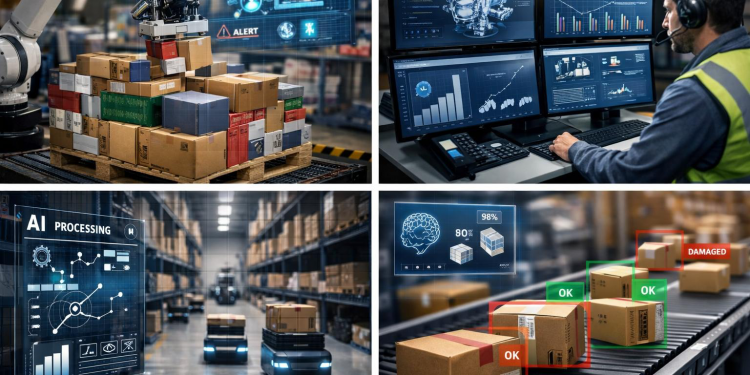
Predictive maintenance is one of them, and AI allows you to turn uptime into a managed outcome.
For years, warehouses have dealt with a familiar pattern. A component starts to wear down. Performance slips over time. Everything appears fine until the system finally fails. Then the operation faces an unplanned event. Teams may need to rush parts in, assign more labor to the issue, and work to catch up. This reactive approach leaves value on the table.
When AI is used for predictive maintenance, it looks at signals and patterns to estimate the likelihood of failure. It can also help identify the right time to step in and show the likely impact of waiting too long. That shifts maintenance from a cost center to a reliability program.
This is one of the most practical AI solutions in the warehouse today because it helps protect uptime, support customer satisfaction, and reduce avoidable disruption across the supply chain.
Vision-Based Autonomy
The other area where AI is having a real impact in warehousing is vision-based autonomy. In this case, AI is improving visibility in the physical world.
Vision-based autonomy expands the range of tasks you can automate. This is especially true in areas that have historically depended heavily on labor and where robotic and automated systems have struggled with inconsistency.
For many years, the focus has been on moving products out the door faster. Today, warehouses also need to address the problems caused by day-to-day variation.
You may be dealing with different packaging types, inconsistent case presentation, damaged cartons, mixed layers, mixed pallets, and other hard-to-handle conditions during normal operations. Traditional automation works best with structured inputs. Vision-based AI, combined with robotics and controls, allows the system to read less structured scenes and act safely on the warehouse floor.
This is one clear answer to the question of how AI improves warehouse automation and robotics. It helps systems perform tasks in less predictable conditions and manage more real-world variation in order picking, handling, and quality control.
Warehouse AI Should Start Small
While AI offers many possibilities, it is best to take an incremental approach rather than trying to do everything at once.
Start by choosing one mission-critical use case. This might be depalletizing, for example, to reduce downtime caused by frequent variations in product presentation.
Next, measure the “cost of chaos.” Understand what your downtime minutes look like, how much throughput swings from shift to shift, and what safety incidents you have experienced. This gives you a foundation for your next moves with AI.
It also helps show where AI may improve accuracy, support better decisions, and strengthen performance over time.
After that, design the workflow first. Be clear about who receives the insights AI provides and who is expected to act on them. Make that a standard routine before trying to scale it.
As with any new tool or technology, you need to pilot AI for day-to-day adoption. If it does not fit into daily management, it will not scale well.
Finally, scale by template. That means replicating the tool and the process across lines and sites with minimal reinvention. This is where warehouse management systems WMS and connected tools can help support repeatable execution, manage inventory, and improve visibility into stock levels while optimizing inventory over time.
The Future of Warehouse AI
Going forward, your DC should treat AI as a practical set of tools. When those tools are paired with disciplined operations, they can help turn uptime, flow, and safety into managed outcomes.
The goal is to reduce variation, improve consistency, and make performance repeatable regardless of volume swings or labor constraints. AI is a tool that can help make that possible.
When implemented with clear workflows and data, warehouse AI can improve how facilities operate, support better decisions on the warehouse floor, and help operations respond more effectively to changing demands.
Contributors:
Matthew Theriault-Thompson, Toyota Automated Logistics
Onur Uranli, Honeywell Intelligrated
Reviewed by MHI Solutions Community Marketing Committee
For more information about the Solutions Community: mhi.org/solutionscommunity
For further articles from the Solutions Community:
Warehouse KPI Examples: What KPIs Really Matter?
Is It Time to Upgrade Your WMS Systems?
Peak Season Warehouse Training for Seasonal Employees
Knowing When to Replace Warehouse Automation Equipment
Converging IT with OT Strategies
Go-Live Best Practices for Warehouse Automation
From If-Then to Intelligent Agents in Intralogistics Condition Monitoring
Cabinet-Free Warehouse Automation: Modular, Scalable Systems